
Quick answer: The first 10 minutes after a truck or trailer breakdown are critical. Get safely off the travel lane and turn on your hazard lights first. Set out your warning triangles as soon as it is safe to do so. Do a quick visual check for tire position, leaks, and warning lights, but do not try to diagnose the problem deeply or go under the truck. Call for help with your exact location and unit details ready. Before help arrives, secure the load and take photos of the truck, trailer, and visible damage. In order, focus on safety, visibility, a quick assessment, calling for help, and documentation to reduce risk and downtime.
A truck or trailer breakdown can throw off an entire day. You may be stuck on the shoulder with traffic moving around you, a delayed load, and downtime mounting by the minute.
What you do in the first few minutes after a truck or trailer breakdown can make a big difference.
The right steps can keep you safer, help roadside assistance reach you faster, and prevent a small problem from getting worse.
Here's the order that actually matters and why staying calm matters in each step during a roadside breakdown.
Step 1: Pull Over Safely and Turn on Your Hazard Warning Lights
If the truck is still drivable, move it as far away from the travel lane as you safely can. A wide shoulder, exit ramp, rest area, or truck stop is much better than stopping in an active lane. If possible, avoid stopping on a curve or near the top of a hill, where approaching drivers may have less time to see you.
Once stopped, turn on your hazard lights right away. If the trailer has a reefer unit, leave it running for now and focus on securing the vehicle first.
Set Your Reflective Safety Triangles
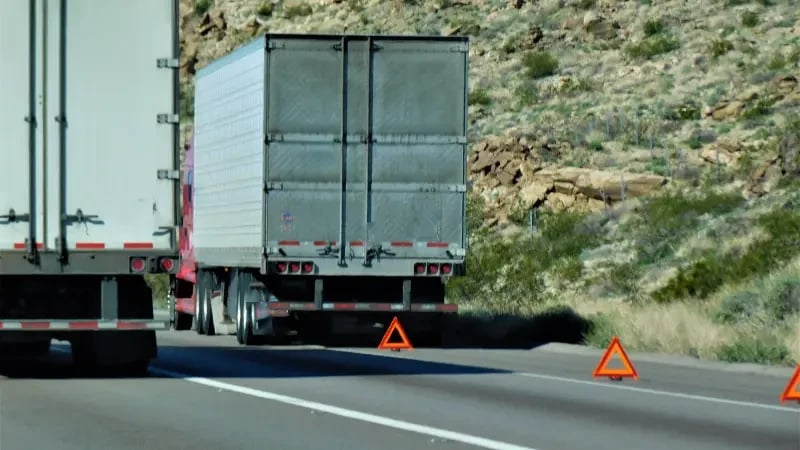
Federal safety standards require drivers to deploy warning devices within 10 minutes of stopping to ensure oncoming traffic has enough visibility to slow down or change lanes safely.
Spacing varies depending on whether you are parked on a straight, open road, a divided highway, or near a blind spot, such as a hill or a curve.
Two-lane road (traffic in both directions)
On a standard two-way road, you need to warn drivers approaching from both directions.
- One triangle 10 feet in the direction of approaching traffic (which can be either front or rear).
- One triangle 100 feet behind the truck
- One triangle 100 feet in front of the truck, to warn oncoming traffic from the other direction
Hills and Curves
Near a hill or curve that blocks visibility, move the farthest triangle closest to the obstruction between 100 and 500 feet back, giving approaching drivers ample time to see the warning before reaching the blind spot.
Divided highway or interstate (traffic only from behind)
Since a median separates opposing traffic, place all three triangles behind the truck.
- One triangle placed 10 feet behind the truck
- One triangle placed 100 feet behind the truck, in the center of the lane
- One triangle placed 200 feet behind the truck, in the center of the lane
Step 2: Assess the Situation
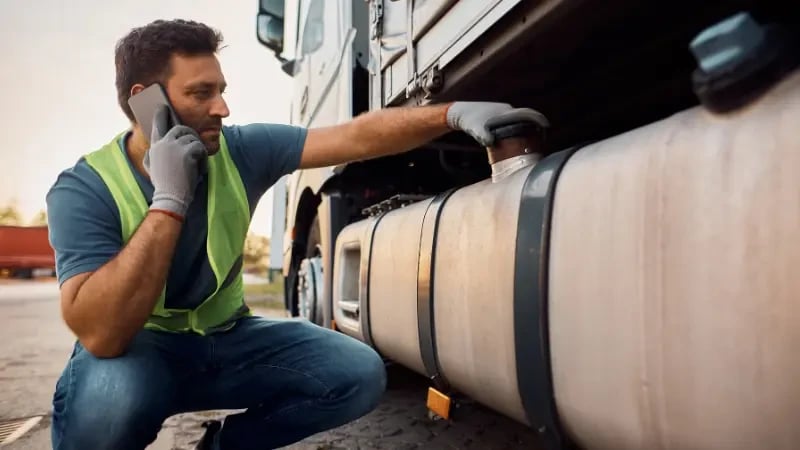
The second step is to identify the problem and determine whether you can fix it or need a truck or trailer service provider. A quick visual check helps the roadside provider bring the right parts and equipment.
Look for:
- A blown or damaged steer, drive, or trailer tire
- Oil, fuel, or coolant leaks, or an obvious air leak
- Broken or dangling parts
- Dashboard warning lights or fault codes
- Any unusual noise or a sudden loss of power before the truck stopped
If a steer tire has failed, stop and do not continue driving. For a drive or trailer tire failure, pull over as soon as it is safe and avoid driving farther unless a qualified provider confirms it is safe to do so.
Once you have the basic information, get back in the cab or another safe location rather than spending unnecessary time on a live shoulder.
Should You Try to Fix it Yourself?
Only handle simple issues you can address safely without going under the truck or working on brakes or other heavy components. Adding coolant, replacing a fuse, or reconnecting an obviously loose cable may be reasonable if you know what you are doing.
Leave anything more serious to a mobile mechanic. For example, an overheating semi-truck may have a simple external problem, such as a loose hose, or a more serious internal failure that requires professional diagnosis.
Step 3: Call for Roadside Help

When your truck breaks down, who you call and the order in which you call them matter. Check the following to determine whom to contact in an emergency.
In case of an Injury or Immediate Safety
Call 911 immediately if there is an active injury, fire, hazardous material spill, or if your vehicle is stranded in a live traffic lane creating an immediate danger to oncoming motorists.
For Nearby Mechanics
Use a truck breakdown directory or roadside service for a normal mechanical, tire, electrical, brake, or air-system failure.
For Route and Load Logistics
Update your dispatcher or fleet manager once help is on the way so they can manage the load, route, and delivery schedule.
Claims and Coverage Verification
If the incident may involve towing, collision damage, cargo damage, or a major repair that could be covered.
Before you dial, have this ready so the call takes two minutes instead of ten:
- Exact location: highway, direction of travel, nearest mile marker or exit
- Unit ID for the truck and trailer
- What happened and what you observed, sudden or gradual, any noise, any warning light
- Photos of the dashboard, the damage, and the surrounding scene if you can safely get them
This is exactly the situation a truck breakdown directory is built for. Instead of scrolling through a saved contact list hoping someone still answers, or guessing which shop is actually close to you, search your real location on SemiDown and see verified repair shops, mobile techs, tire services, and towing providers that are actually near you right now.
Step 4: Secure the Load and Document Everything

Once help is on the way, secure the truck and load. Set the parking brake, and when safe and necessary, use wheel chocks to prevent movement.
If you are hauling refrigerated freight, confirm that the reefer is still running and maintaining the correct temperature. Keep the trailer doors closed and continue monitoring the temperature while you wait.
Take a few photos before repairs begin:
- The truck, trailer, and surrounding scene
- Dashboard warning lights and fault codes
- Visible damage, leaks, or failed components
- Unit and trailer numbers
- Cargo or load condition if it can be checked safely
Also record when the breakdown occurred and when you called for help. If your ELD supports annotations, add a brief factual note such as: “Mechanical breakdown, I-80 westbound, waiting for mobile repair.”
These details give your dispatcher, repair provider, and carrier a clear record of what happened.
Can a Breakdown Give You Extra Driving Time?
A breakdown can take a big chunk out of your available driving time, but it does not automatically give you extra hours. Under Federal Hours of Service rules, the adverse driving conditions exception applies to unexpected weather, road, or traffic conditions that could not reasonably have been known before the trip. A mechanical failure does not fall under that definition.
- The adverse driving conditions exception applies to unexpected road, traffic, or weather conditions, not to mechanical problems.
- Time spent repairing, getting assistance for, or attending a disabled commercial vehicle is generally considered on-duty time under 49 CFR 395.2.
- If you run out of legal driving time, the fact that the truck has now been repaired does not automatically allow you to continue driving.
Time spent waiting for the repair counts as on-duty, not driving, and still counts against your 14-hour window and weekly limit. If the repair eats into your available hours, you'll need a full 10-hour off-duty reset before driving again; plan to sleep at the shop or nearby.
How Long Can You Legally Stay on the Shoulder?
There's no single federal limit, but most states will have you towed within 24 hours if you're parked on a highway shoulder. Shoulders aren't parking spots; they're for emergencies, and some states will ticket extended shoulder parking even with triangles properly deployed. If a repair will take more than a few hours, finding a towing and recovery service is a smart choice. Sending your rig to a proper facility is usually safer and cheaper than waiting it out on the roadside.
Tow, Roadside Repair, or Drive to a Safer Spot?
Once you know what's wrong, you're left with one more decision, and getting it wrong either way costs you money or time you don't need to lose.
Choose This | When |
|---|---|
Drive a short distance to safer parking | The issue is limited and understood (a drive or trailer tire, a minor leak with no other symptoms), and a safe spot is within 5 to 10 miles |
Roadside repair | You're already somewhere safe, and the problem is realistically fixable on-site: a stuck thermostat, a split hose, a tire, a minor electrical issue |
Tow | The truck is in a dangerous spot with no safe workspace, the failure is internal (blown head gasket, seized water pump, brake system compromise), or a steer tire is involved |
When you're not sure which one applies, tow it. Paying for a tow on something minor is a small loss. Driving on real internal damage and turning a simple repair into a full rebuild is not; and before you hand your truck over to whoever answers the phone first, avoid a few common mistakes before finalizing a repair shop. Get written estimates instead of verbal quotes, and check verification and online reviews, among other things, if you need it done fast.
What Every Trucker Should Carry in Their Emergency Breakdown Kit
A roadside breakdown is easier to manage when basic safety equipment and supplies are already in the truck. Keeping a few essentials on hand can help you secure the area, inspect the problem safely, and communicate with roadside assistance.
- Keep three reflective warning triangles, a high-visibility safety vest, and a fire extinguisher rated 5 B: C or higher, as required by FMCSA.
- Carry wheel chocks for when you need extra protection against vehicle movement.
- Keep a flashlight with fresh batteries and a basic tool kit with wrenches, pliers, and screwdrivers.
- Carry jumper cables, a tire pressure gauge, and spare fuses for simple problems you can safely identify. If the repair requires a replacement component, use a directory to find nearby truck and trailer parts dealers.
- Keep a phone charger and backup battery pack so you can contact roadside assistance, your dispatcher, or emergency services.
- Carry basic fluids and supplies appropriate for your truck, such as coolant and DEF, but do not use temporary fixes for a problem that requires professional repair.
- Keep drinking water, a blanket, and non-perishable food in the cab in case roadside assistance takes longer than expected.
These supplies will not replace a proper roadside repair, but they can help you stay safe, provide better information to the repair provider, and avoid unnecessary delays while you wait for help.
Frequently Asked Questions
The Bottom Line
The first 10 minutes after a truck or trailer breakdown are about staying safe and getting the right help quickly. Move to a safe location if possible, turn on your hazard warning lights, identify the obvious problem, contact roadside assistance, and document what happened. Taking these steps can help the repair provider arrive better prepared and reduce unnecessary delays.
Breakdowns can happen far from your regular repair shop or in an unfamiliar area. When you need help nearby, use SemiDown to find truck and trailer repair shops, mobile mechanics, tire services, and towing providers near your location.